

Lab Report: Does Wealth Buy (Species) Richness?
Contributor
- Topics: Growing for Biodiversity, Lab Report
Summer 2026
Studies of the ‘luxury effect’ on biodiversity in garden spaces
The term biodiversity refers to the variety of life on Earth. Although biodiversity can refer to any level of the biological hierarchy, from genes to ecosystems, it most often refers to the number and relative abundance of different species in an area. Specifically, the number of unique species in an area is known as species richness, which I will loosely refer to as biodiversity throughout this article.
Economically, biodiversity is important for maintaining the plant- and animal-derived products we enjoy for food, fiber, timber, and medicine. Scientists have also established a direct connection between higher levels of species richness and the healthy function of ecosystem processes, including pollination, pest control, climate regulation, and nutrient cycling.
Biodiversity also bolsters the recreational opportunities, aesthetic beauty, and sense of local heritage that the natural world confers on our mental health. In fact, the cultural benefits that we derive from biodiversity are considered so fundamental to the human experience that E. O. Wilson formalized and popularized “The Biophilia Hypothesis” in his 1984 book, Biophilia. This hypothesis suggests that humans have a deep psychological and emotional drive to explore and seek connections with the natural world.
Given the economic and intrinsic value of biodiversity to our lives, it should be no surprise that scientists have been observing, describing, and classifying organisms and patterns of biodiversity since the time of Aristotle (ca. 300 BC), through Linnaeus (1700s), Darwin (1800s), and into the modern era with the formation of the Society for Conservation Biology (1980s).
Today, advances in statistics, open-access databases, and computing power have allowed us to explore increasingly complex models of biodiversity to better understand the evolutionary, geomorphic, ecological, and socioeconomic factors that promote or degrade biodiversity across spatial scales.
Historically, most studies of biodiversity have concentrated on natural systems. Starting in the early 2000s, scientists started studying the diversity of life in cities and suburbs.
An array of interacting factors influence patterns of urban biodiversity, including neighborhood microclimate, topography, green space, tree canopy cover, land management practices, and local plant nursery inventories. Over the past few decades, researchers have paid increasing attention to the impact that household and neighborhood wealth can exert on local levels of biodiversity. Specifically, multiple studies have shown that biodiversity increases with neighborhood affluence, a relationship termed the “luxury effect” by Hope and colleagues in 2003.
In this column, I review scientific studies that focus on the luxury effect in garden spaces. I selected studies that focus on plants, because garden plant communities reflect the conscious (and likely subconscious) actions of gardeners, against the backdrop of ecological, social, and market influences. In addition, biodiversity at the level of plants serves as the basis for the biodiversity of insects, birds, and other organisms that make use of garden spaces. Plant it and they will come.
Socioeconomics drive plant diversity across land use types in Phoenix
Hope and colleagues (2003) conducted their study of woody plant diversity in the Phoenix metropolitan region, where agriculture and Sonoran Desert natural areas surround urban sites. The researchers hypothesized that geomorphic factors (such as elevation and precipitation) determined woody plant diversity within the desert, but that distance from city center and urban land use type (such as private yard, commercial, institutional, recreational, or industrial) determined plant diversity within urban sites.
To test their prediction, they set up 30-square-meter (322-square-foot) quadrats across Maricopa County, Arizona, spanning urban, agricultural, or desert spaces. Within each quadrat, they mapped, measured, and identified all woody perennial plants to species (or genus, for difficult-to-identify plants), but not to the level of horticultural cultivars. They extracted socioeconomic variables for each quadrat from census data available through the US Census of Population and Housing.
The researchers then created a series of statistical models to identify the factors that best predicted the spatial variation of woody plant biodiversity within each site. They looked to three main influences when determining variables that might predict plant diversity across the entire Phoenix metropolitan region, as well as within the urban sections of the region. First, They included geomorphic factors such as latitude, longitude, and elevation. They also included anthropomorphic aspects such as land use type, soil nitrate, distance from urban center, distance from nearest major freeway, number of years in agriculture, and whether the land was ever used for agriculture. Finally, they considered and socioeconomic factors such as population density, median housing age, and median family income.
Across the entire Phoenix metropolitan region, they found that woody plant diversity was best explained by land use type, elevation, and median family income. Specifically, woody plant diversity increased with elevation and income, with highest levels of diversity generally associated with urban sites. Within urban sites, woody plant diversity increased with median family income and decreased as in areas with older housing.
Across all variables measured, neighborhood affluence emerged as a dominant factor influencing woody plant diversity at regional and neighborhood scales. However, the authors also found some correlations among explanatory variables that make it difficult to isolate affluence as the primary driver of biodiversity. These correlations include a positive relationship between income and housing age as well as income and elevation. The authors suggest that the housing age effect might relate to a preference for newer housing among the wealthy, or may be due to changes in landscape designs over time result in more woody plant genera in newer housing developments. In terms of the correlation between elevation and income, wealthier neighborhoods in the region tended to be at higher elevations (as is the case for many American cities). Thus, it was hard to tease apart the “extent to which wealthier people create more diverse landscapes or simply acquire them.”
The luxury effect in California’s food-producing community gardens
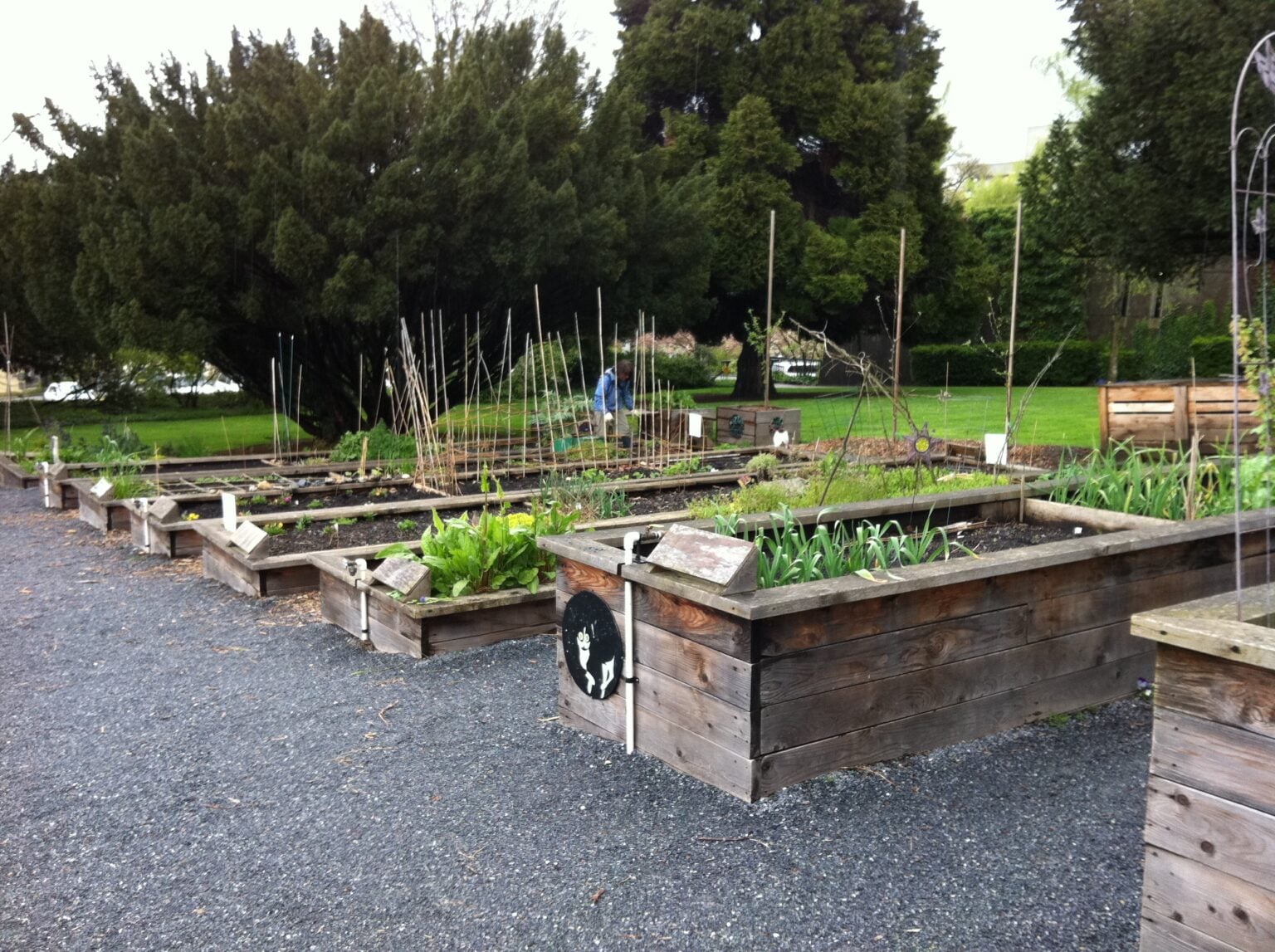
Community gardens have a long history of being established on unused and derelict land. Somewhat ironically, as the land value improves via the hard work of community gardeners and general real estate market forces, community gardens are at greater risk of being sold or allocated to another use. Thus, many community gardens suffer from low land tenure security, and risk being evicted from the garden space with little to no notice. Philpott and colleagues (2023) studied how urban plant communities in garden spaces are influenced by land tenure security and local measures of wealth. They hypothesized that crop species richness would increase with land tenure security, and that ornamental plant richness would increase in wealthier neighborhoods.
To examine their hypotheses, they documented the diversity of crop, ornamental, and weedy plants across 23 community gardens in California’s Central Coast region. They measured garden size, garden age, management type (such as allotment versus single-manager), and the size of plots within each garden.
They also gathered socioeconomic data for the ZIP Code associated with each garden. They used census data to determine median household income and the percent of owner-occupied housing, and 12-month averages of Zillow home values for property values.
The researchers classified land tenure on a scale of 1 to 4, where gardens classified as 1 were at imminent risk of eviction, those classified as 2 had short-term memorandums of understanding with the property owner, gardens classified as 3 had long term leases with the property owner, and those classified as 4 had ownership of the land.
Increasing land tenure security increased total plant species richness and crop species richness within gardens. They found that crop species richness increased with surrounding property values but declined with median household income. Ornamental plant species richness also increased with surrounding property values but decreased with the percent of owner-occupied housing units. Weed species richness was not influenced by socioeconomic factors. Thus, all three measures that the authors used to measure the luxury effect (property values, median household income, percent owner-occupied housing) impacted the diversity of ornamental and crop plants within community gardens. However, their results were not as straightforward as they had predicted.
They suggested that their results might have departed from their predictions for four reasons. First, two of their study gardens were located on the campus of University of California, Santa Cruz. Due to the number of students who lived in the area, owner-occupied housing units were among the lowest in the study and property values were lower than surrounding areas.
Second, these two gardens were primarily managed by paid university employees. Thus, non-students determined the diversity of plants cultivated or weeded out of these gardens, even though students exerted a strong influence on socioeconomic variables for these sites.
Third, they suggested that the predictions of the luxury effect may not fully extend to community gardens, where rules and policies can influence how people garden as much or more than socioeconomic norms in local neighborhoods.
Finally, they noted that percent owner-occupied housing might indirectly influence plant diversity within community gardens, particularly if homeowners choose to plant certain types of plants at home (ornamentals), while using their community garden plot for other types of plants (crops).
Nonetheless, they found that total plant species richness, crop species richness, and ornamental plant species richness within community gardens are tied to land tenure security and measures of local wealth. Thus, even in spaces that are focused on function over aesthetics, affluence appears to drive local plant biodiversity.
Money is more important than time for plant biodiversity in Baltimore-area yards
Avolio and colleagues (2020) studied the interaction between yard size and human resources (such as time and money) on plant biodiversity across 12 neighborhoods and 96 yards in Baltimore City and Baltimore County, Maryland.
They included yard size, because many studies have shown that larger yards can host higher levels of plant diversity. They measured and categorized yards into small, medium, or large tracts (spanning from as little as 0.01 acre or 40 square meters, to as large as 0.24 acres or 971 square meters) and documented the diversity of lawn species, flowering plants, trees, and invasive plant species.
For human resource variables, they selected three neighborhoods that fit each of these four categories: higher income, retired; higher income, working, middle income, retired; and middle income, working.
Higher-income neighborhoods were those where the median household income was between $70,000 and $91,000 per year. Middle income neighborhoods were those where median household income was between $45,000 and $56,000 per year. Neighborhoods in the retired category included those with fewer working-aged individuals (23 to 35 percent of residents older than 65). Neighborhoods in the working category included more working-aged individuals (11 to 20 percent of residents older than 65).
They identified lawn plants to species and classified them as either intentionally planted turfgrass or weeds. They also identified flowering plants to genus, and trees to species. They identified invasive plants to species and also categorized them as intentional or weedy.
The researchers documented 82 lawn plant species, of which only five were intentionally planted turfgrasses, the other 77 species were weeds. They documented 80 genera of flowering plants and 89 tree species. They also found at least one invasive plant species in 88 percent of yards surveyed. Most invasive plants (75 percent) were spontaneous weeds, but there were several species that were intentionally planted, such as English ivy (Hedera helix), tree of heaven (Ailanthus altissima), porcelain berry (Ampelopsis glandulosa), and wineberry (Rubus phoenicolasius).
The authors found no effect of yard size or human resource category on lawn plant species richness. As the authors note: “every lawn was equally weedy.” (Avolio et al. 2020) Larger yards, however, held more plants and had a higher diversity of flowering plant genera, tree species, and invasive species.
The luxury effect was supported by study data, with higher-income yards hosting more flowering plant genera, more tree species, and more invasive plant species than middle-income yards. Note that the authors controlled for yard size when conducting their analyses. Thus, their results are tied to differences in household income between yards, and not to differences in yard size.
Notably, they did not find an impact of lifestyle (such as working-age or retired-age households) on plant species richness among yards. This suggests that it is income, and not available time to garden, that is driving differences in plant species richness between yards.
Closing thoughts
Research on the luxury effect in garden spaces suggests that neighborhood and personal affluence (or lack thereof) can structure or constrain garden plant communities. Although I focused on studies of plants in this article, other studies have shown that the luxury effect also applies to insects, birds, and even bats. Beyond the luxury effect, more study is needed before we can fully capture the complex factors and interactions that drive or constrain biodiversity in garden spaces.
I decided to explore the luxury effect in this article because I am genuinely curious about the factors that influence urban biodiversity, including those factors that might not receive much thought. The presence and location of community garden sites, pop-up plant sales, municipal tree giveaways, retail nurseries, big box stores, local extension offices and gardening groups can all shape the look and function of our gardens, in ways that are not immediately obvious. Recognizing the potential or actual presence of the luxury effect provides an opportunity to view garden biodiversity in a new light, and to potentially take action to grow garden-based biodiversity across broader spatial scales.
Read the Last Lab Report Next:
Lab Report: Microplastics in Gardens and Landscaping
By: Anna Perry & Dr. Gail Langellotto
Plastics include a variety of common polymers. They’re found in many garden products including polyethylene sheeting, polyvinyl chloride pipes (also known as PVC), and things containing nylon or polyester fibers like weed fabric, grow bags, and netting. As these plastics degrade into ever smaller pieces, they become microplastics, which are plastic particles between one micrometer and five millimeters long. >>Read Now
Read the Entire 'Lab Report' Catalog
We have collected all of our published ‘Lab Reports’ from over the years into their own category. Check them out today to see how science has shaped our understanding of the Horticultural World we live in! >>Lab Report Archives
Resources
Wilson, E. O. 1984. Biophilia. Harvard University Press.
Avolio, Meghan, Allison Blanchette, Nancy F. Sonti, and Dexter H. Locke. 2020. “Time is not money: income is more important than lifestage for explaining patterns of residential yard plant community structure and diversity in Baltimore.” Frontiers in Ecology and Evolution 8: 85.
Hope, Diane, Corinna Gries, Weixing Zhu, et al. 2003. “Socioeconomics drive urban plant diversity.” Proceedings of the National Academy of Sciences 100: 8788–8792.
Philpott, Stacy M., Peter Bichier, Genesis Perez, Sharlene Jha, Heidi Liere, and Brenda B. Lin. 2023. “Land tenure security and luxury support plant species and trait diversity in urban community gardens.” Frontiers in Sustainable Food Systems 7: 1195737.
This Article is Sponsored by:

Share:
Facebook
LinkedIn
Email
Print


Responses