


As Above, Not So Below: The Underground Truth About Tree Roots
Contributor
- Topics: Sustainable Gardening
Spring 2026
I’ve seen a familiar pattern repeat itself in residential landscapes: thoughtful, well-intentioned changes made at the surface that quietly alter conditions below ground. We replace lawns, add patios, smooth grades, and tuck in new plantings. The work is often done carefully and with confidence, and at the time, nothing appears amiss. The result is orderly, finished, and visually resolved.
Years later, long after the project feels complete, subtle signs of stress begin to show in nearby trees. Growth slows. Canopies thin. Branches decline unevenly. By then, most people have long forgotten about the work that took place near the tree. Few connect what happened at the soil surface with what’s unfolding in the canopy above.
In landscape projects, people often make decisions without a clear understanding of how trees function belowground or how sensitive root systems are to changes in soil structure, oxygen availability, moisture movement, and biological activity.
Without a shared mental model of soil function and root response, a series of seemingly reasonable decisions can accumulate consequences over time. Identifying a few of these common patterns can clarify how trees experience landscape decisions, often in ways we don’t immediately see.
Misconception 1: Roots grow deep
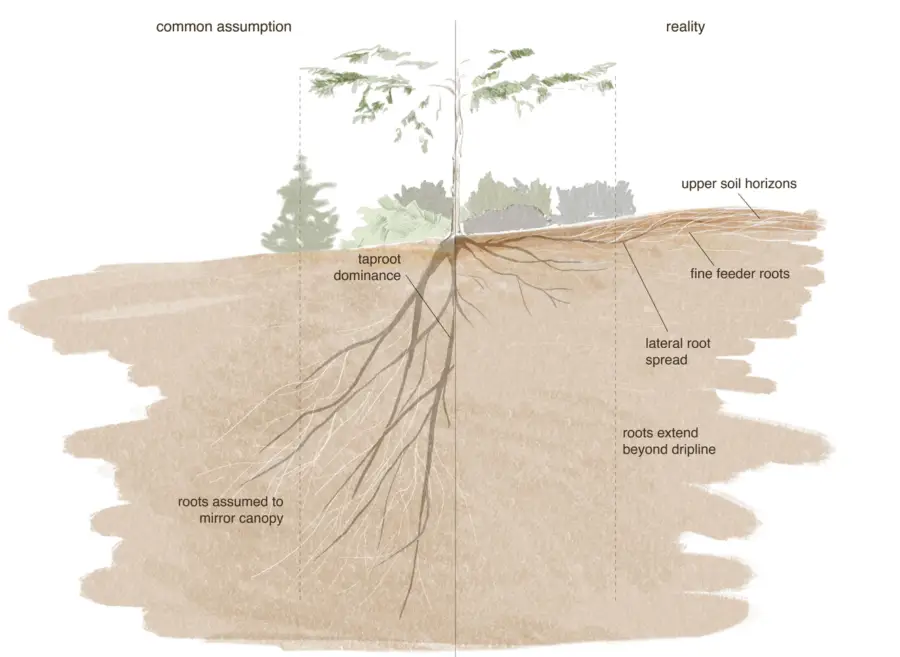
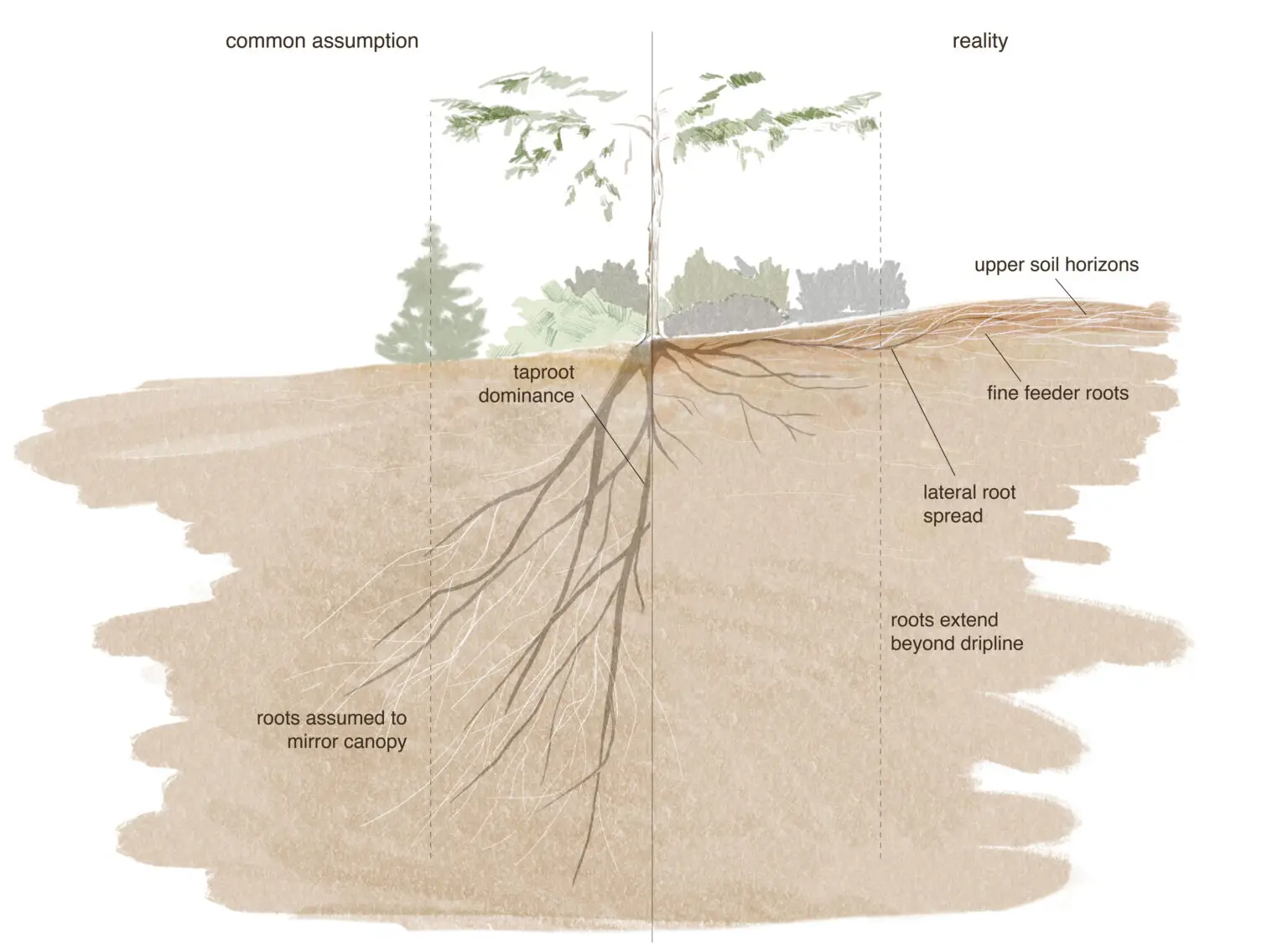
Roots are often imagined as mirror images of the canopy—a deep, symmetrical structure anchoring the tree directly below it. In reality, most tree root systems are far wider than they are deep.
Decades of root excavation research—including the detailed work of Erwin Lichtenegger and Lore Kutschera—demonstrate that most functional roots spread laterally and concentrate in the upper soil horizons, often extending two to three times beyond the canopy drip line in search of water and nutrients. While young trees may start with a taproot, that dominant vertical root typically diminishes in importance as lateral roots expand and assume primary function.
Over time, structural and absorbing roots spread horizontally through the soil profile. Most of a tree’s absorbing or feeder roots—the fine, short-lived roots responsible for water and nutrient uptake—occupy the upper few inches of soil and often extend the furthest beyond the canopy drip line. These are not the large, woody structural roots we see at the base of the trunk, but a dense network of fine roots that are easily severed or suffocated during construction.
This distribution reflects where resources are available. Most organic matter, nutrient cycling, oxygen exchange, and rainfall infiltration occur in the upper soil horizons. Roots proliferate where conditions support respiration and nutrient uptake.
Because dense canopies intercept rainfall, roots often extend well beyond the drip line where precipitation more readily reaches the soil. This lateral spread is normal and adaptive.
Rooting depth is governed less by species stereotypes than by site conditions. Root distribution is strongly influenced by site conditions, including soil texture, oxygen availability, moisture patterns, and the presence of restrictive layers like paving.
In most residential settings, these factors concentrate functional roots in the upper soil layers—often far closer to the surface than many people realize.
Irrigation practices also shape root distribution. Frequent, shallow watering—common in turf irrigation—tends to concentrate roots near the surface. During establishment and extended dry periods, less frequent but more substantial watering can encourage roots to follow moisture deeper into the soil profile.
Because functional roots often occupy the upper soil layers, they may be far closer to surface work than expected. When planning construction, grading, or trenching, it is prudent to assume roots extend well beyond the visible canopy and to limit disturbance accordingly.
Figure 1 — Root Distribution
Root architecture: common assumption vs. reality
Misconception 2: Surface treatments of the landscape are simply aesthetic
Many residential improvements are planned at the surface, but they reshape the soil beneath them.
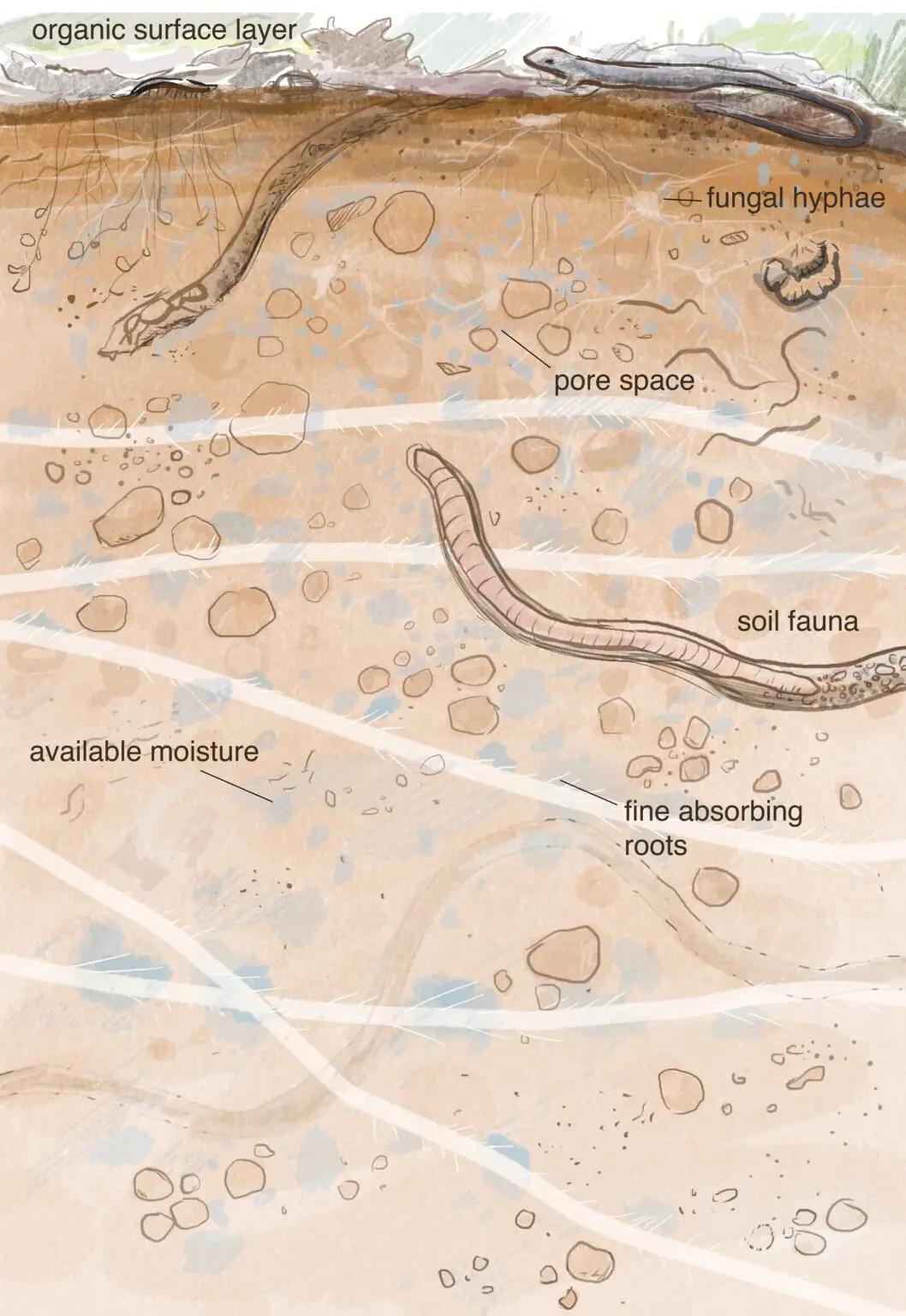
Soil is not static. It functions as a living system—structured by pore space, biological activity, moisture movement, and gas exchange.
Compaction and grade changes are the two most common disruptions. Compaction occurs when soil is subjected to pressure from equipment, foot traffic, or hardscape installation—particularly when soils are moist. As particles are pressed together, pore space declines and the soil environment shifts.
Grade changes introduce a related problem. Cutting soil can sever all kinds of roots, including those well beyond the canopy drip line. Filling soil over existing root zones compresses underlying layers and alters the conditions roots have adapted to.
Most absorbing roots occupy the upper soil horizons where organic matter and aeration are greatest. Burying these layers alters gas exchange and moisture movement, often reducing fine root function over time. In many species, prolonged burial of structural roots or the trunk flare increases decay risk and can trigger the formation of adventitious roots. While this response may allow short-term survival, it can also lead to unstable root architecture or potentially the development of girdling roots in constrained soils.
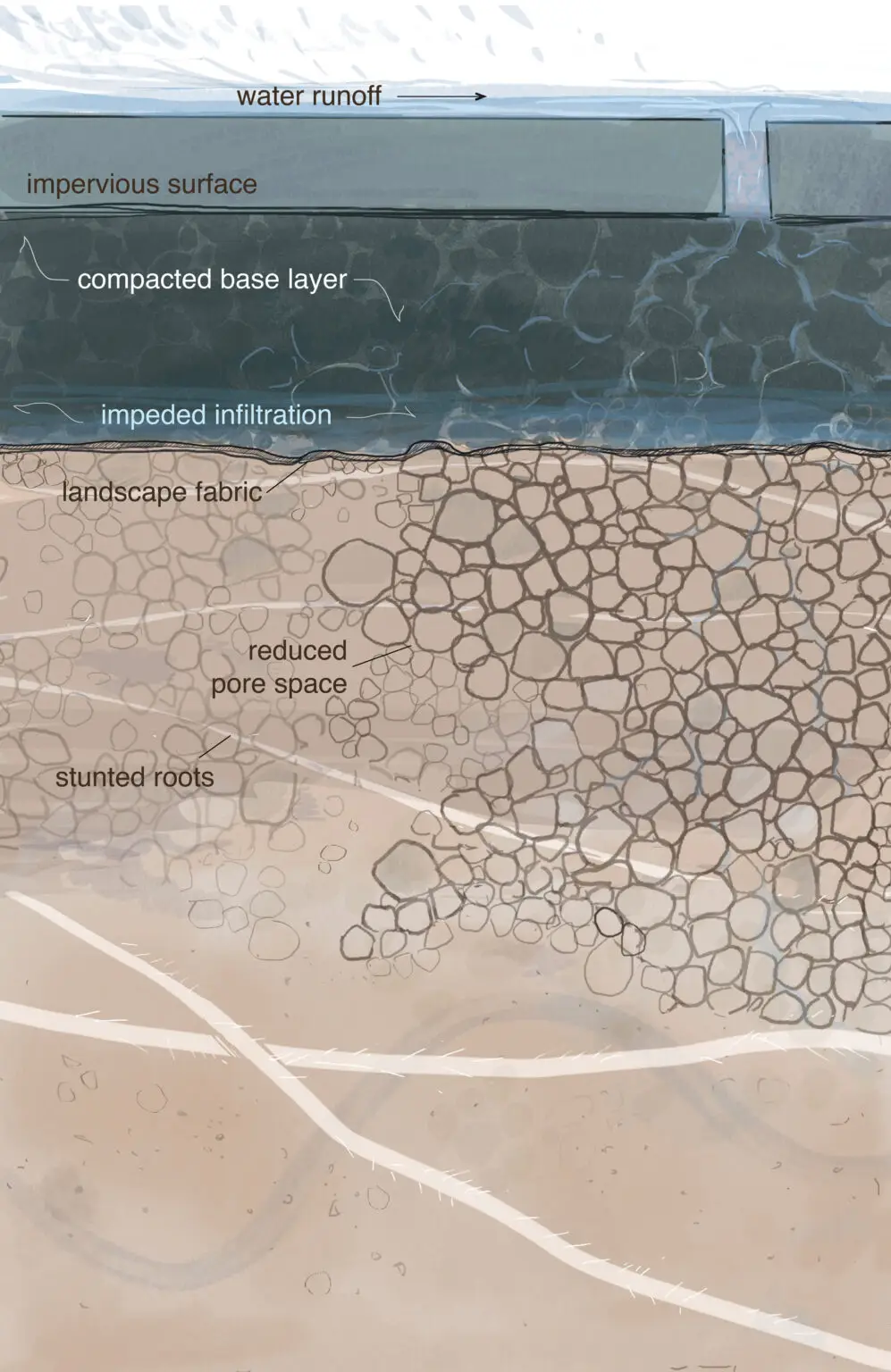
Hardscape systems require compacted base materials engineered to resist movement. While structurally necessary, these dense layers alter the soil conditions below and around them. Compaction often extends beyond the hardscape footprint through staging of equipment and materials as well as workers’ foot traffic and heavy equipment use.
Surface treatments that replace organic groundcover with gravel, landscape fabric, synthetic turf, or paving change more than appearance. They alter how air, water, and organic inputs move into the soil. Gravel does not contribute organic matter and is often installed in multiple inches over fabric or compacted bases. Synthetic turf and traditional hardscape systems rely on densely compacted aggregate layers. In urban ecology, this condition is often referred to as soil sealing.
Surface materials also influence temperature and moisture patterns. Organic mulches buffer soil temperatures and reduce evaporation. Rock and dense materials absorb and radiate heat, increasing temperature extremes and failing to retain moisture near the soil surface.
The effects are rarely immediate. Instead, soil structure and root function gradually adjust to the new constraints. Because tree roots depend on oxygen to function, extensive soil sealing—especially within the critical root zone—can significantly impair root function and, in severe cases, lead to tree decline or mortality.
When existing trees are to be retained, minimizing the construction footprint and intensity of compaction in these areas is needed. If work access or circulation near root zones is unavoidable, temporary load-spreading measures—such as thick mulch layers or ground protection mats—can help reduce surface compaction during site activity.
Figure 2 — Healthy Soil
Healthy soil: a living system
Misconception 3: If the tree looks fine, it is fine
Trees allocate and conserve energy in slow cycles. Because of the way they have adapted to survive, visible signs of stress often appear long after the initial disturbance. By the time decline is noticeable, the underlying injury may be years old.
Research into tree biology, including the work of Alex Shigo and Harold Marx (1977), has shown that trees do not “heal” in the way animals do. Instead, they compartmentalize injury—isolating damaged tissue to limit the spread of decay. Some species are more effective at this than others.
When construction or grading cuts roots, the tree responds much as it would to a pruning wound aboveground—by attempting to wall off the injured tissue. Roots are living organs, and severance is a form of wounding. The success of that response depends on species, soil conditions, timing, and the extent of injury. Roots cut cleanly with a sharp spade or saw generally compartmentalize more effectively than roots that are torn, ripped, or crushed during excavation.
Trees routinely shed their fine absorbing roots and regenerate them under healthy conditions. Structural roots—which provide anchorage and long-term transport—are not so easily restored. Compacted or oxygen-limited soils can compromise the tree’s ability to compartmentalize an injury, and decay organisms may gain access before protective barriers fully form.
Longer-lived species, such as many oaks (Quercus spp.), often demonstrate greater capacity to store energy and tolerate injury over time. Faster-growing, shorter-lived species—frequently described as pioneer species—tend to allocate energy toward rapid growth and reproduction and may, in some cases, be less effective at walling off decay. These are general tendencies rather than rules; species-specific biology ultimately governs response.
Age also matters. As trees mature, their capacity to respond to new stress can change. While older trees may hold substantial stored energy, their ability to replace lost tissue or adapt to new disturbances is often reduced compared to younger trees with more responsive growth systems.
The absence of immediate symptoms does not necessarily indicate the absence of impact. Underground injuries rarely announce themselves immediately. Instead, trees compensate. Over time, this may show up as crown dieback, limb loss, reduced flowering or fruiting, or slower annual growth.
Stress compounds. A tree already managing drought, flooding, or soil disturbance has less capacity to respond to additional injury. Cultural stressors—over-pruning, mower damage, excessive fertilization, poorly calibrated irrigation—further reduce resilience.
Timing also influences recovery. The season in which injury occurs, the proportion of roots affected, and the species involved all shape the outcome.
When root disturbance is unavoidable, coordinating advance root pruning and protecting surrounding soil conditions can reduce the likelihood of uncontrolled damage during construction.
Figure 3 — Compacted Soil
Compacted soil beneath hardscape installation
Avoiding Pitfalls
All scales require scrutiny
Larger projects often require formal tree protection plans and arborist review. Careful planning includes mapping root zones, measuring disturbance, and discussing impacts before beginning construction.
Smaller projects rarely receive that level of scrutiny. A patio extension, turf replacement, minor regrading—these are often treated as cosmetic improvements, yet smaller scope does not necessarily mean smaller impact.
The assumptions surrounding trees in landscapes are not regional. I’ve seen similar patterns on both coasts. The scale may differ, but the underlying misconceptions are widespread.
Prevention is more effective than repair
Preventing damage is far more reliable than attempting to repair it later. Effective prevention begins before construction. Evaluating existing trees and understanding likely root zones early in the process is significantly more effective than post-construction repair. Once soil structure is significantly altered or fine absorbing roots are lost, recovery can be unpredictable—particularly in species that tolerate disturbance poorly. However, many impacts can be reduced or avoided entirely when soil function is considered early.
Clients have often already formed major preferences about projects before bringing in landscape professionals. They may have set expectations around flat lawns, paved gathering spaces, or irrigation systems before drafting any formal designs. While landscape professionals may not shift every preference, we can introduce foresight into the conversation.
Species vary in their tolerance for root disturbance and soil compaction. Some are more adaptable under altered conditions; others decline gradually despite intervention. Tolerance lists can be helpful reference points, but they are not guarantees. Stress is cumulative, and soil conditions, age, and prior disturbance all influence outcome.
Sometimes prevention means reconsidering a hardscape’s footprint, questioning how flat a lawn truly needs to be, or deciding whether lawn size justifies the soil disturbance required to support it.
Prevention may also mean looking closely at what is labeled “permeable.” Many paving systems marketed as permeable still rely on heavily compacted aggregate bases. Water may move through joints, but oxygen exchange and biological activity below the base layer can remain limited.
Small adjustments in layout, footprint, material choice, and sequencing can significantly influence how much soil function is preserved—often without sacrificing usability.
Some projects need qualified evaluation
Before undertaking significant grading, paving, or soil alteration near mature trees, it can be valuable to involve a credentialed arborist early in the planning process. A consulting arborist evaluates tree health, root protection needs, and potential impacts before construction begins. This role is distinct from pruning or removal services and is often certified by the International Society of Arboriculture (ISA).
An ISA Certified Arborist designation reflects standardized education, examination, and continuing education requirements focused on tree biology, risk assessment, and current research. Not all individuals who work on trees carry this credential, and not all tree service providers operate from a consulting perspective. The ISA maintains a public directory of credential holders, organized by region.
Early evaluation often clarifies which impacts are reversible—and which are not.
Remediation requires careful planning
Once soil structure is significantly altered or absorbing roots are severed, recovery can be unpredictable. Some species rebound. Others decline slowly despite intervention. Soil function can often be improved, but it is rarely restored quickly.
Heavy soil amendments are not always the solution. Established trees generally benefit more from stable conditions than from aggressive inputs. Large changes to soil chemistry or fertility can introduce new imbalances, particularly when root systems are already stressed. In many cases, supporting the existing soil biology—rather than dramatically altering it—yields better long-term outcomes.
The deeper repair may be conceptual. Many of our landscape habits arise from incomplete assumptions—that roots grow deep, that hard surfaces are merely surface decisions, that visible health equals resilience.
When compaction or sealing has already occurred, remove barriers where feasible and restore an organic surface layer such as mulch. Recovery requires patience and restraint. In some cases, carefully selected understory plantings can contribute to long-term soil improvement, but only after conditions have stabilized and further disturbance is avoided. Often, the most effective intervention is simply preventing additional disruption and allowing soil processes to recover over time.
We rarely harm trees out of neglect. More often, we harm them because we misunderstand how they live. Correcting that misunderstanding is a form of care.
Resources
Learn More About the Author: https://www.lloydlandwright.com/
Wageningen University & Research Image Collections hosts digitized copies of root system drawings by Erwin Lichtenegger and Lore Kutschera, also published in the seven-volume Root Atlas (1960–2009).
Gilman, E. F. 1990. “Tree root growth and development. I. Form, spread, depth and periodicity.” Journal of Environmental Horticulture 8(4): 215–220.
Kozlowski, T. T. 1999. “Soil Compaction and Growth of Woody Plants.” Scandinavian Journal of Forest Research 14(6): 596–619.
Perry, Thomas O. 1982. “The Ecology of Tree Roots and the Practical Significance Thereof.” Arboriculture & Urban Forestry (AUF) August 1982, 8(8): 197–211.
Shigo, Alex L. and Harold G. Marx. 1977. Compartmentalization of Decay in Trees. US Department of Agriculture, Forest Service.
Share:
Facebook
LinkedIn
Email
Print


Responses