


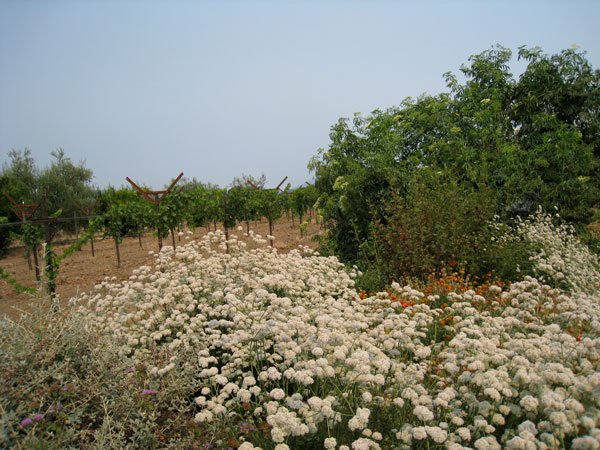
Native plant hedgerows can provide habitat for a diversity of birds, insects, and other small animals, offering food, cover for nesting and overwintering, and safe travel from one area to another. Lists of plants suitable for garden hedgerows are as varied as a homeowner’s landscaping style, wildlife preference, and what the climate dictates, but try to include shrubs, grasses, flowering annuals and perennials, and ground cover. Many habitat plants, especially for native insects, are not well-studied; observant gardeners can contribute significantly to our knowledge of which native plants are best for attracting beneficial insects and other garden allies.
Any of the following lists should be checked with a local native plant nursery for suitability in the individual gardener’s situation. Substitutions are encouraged! Pay attention to available space, and allow room for the hedgerow to grow. With a careful selection of plants, especially those that will support some pruning, hedgerows can be created to fit into even small spaces such as next to driveways and sidewalk strips. Avoid blocking driveway sight lines and be sure to choose plants adapted to the local soil and water availability.
Plants suitable for agricultural hedgerows are not always ideal in gardens, especially some of the large tree species, but if you have enough space, consider including them. Many native trees provide important habitat; for instance, oak trees are known to harbor over 700 species of insects, critical food for nesting birds.
Include plants that provide shelter and forage over a long season by carefully selecting a palette of sequentially flowering plants to provide nectar and pollen for as many months of the year as possible. Remember to include a water source for any wildlife planting; this may simply be a faucet dripping into a basin, a more elaborate pond or—if you are lucky—a nearby riparian stream.
The following plants lists will help you create a hedgerow designed to attract and support specific wildlife. Local native plant nurseries and university extension programs will help you identify additional plants for your specific region. Many native plants appear on more than one of the following lists, and any of these hedgerows will attract a diversity of wildlife.
California Quail Hedgerow
Long ago, I came across a wonderful list of native plants for California quail published by the Golden Gate Audubon Society. I am glad I saved it as it no longer appears on the website. Years went by before I had the opportunity to plant a hedgerow for quail. If you love this iconic little bird as I do, and would like to provide habitat, be sure to include native lupines as many species provide good forage. This list is adapted from the original handout; starred plants are especially recommended.
Shrubs/Trees
Arctostaphylos spp. Manzanita .
Atriplex lentiformis spp. brewerii Saltbush/quailbush*
Baccharis pilularis Coyote bush*
Ceanothus spp. Ceanothus (especially those that provide cover)
Cornus spp. Dogwood
Frangula californica Coffeeberry
Heteromeles arbutifolia Toyon
Lupinus spp. Lupine*
Myrica californica Wax myrtle
Quercus agrifolia Live oak*
Rubus ursinus California blackberry*
Rubus parviflorus Thimbleberry*
Salix spp. Willow*
Perennials and Annuals
Anaphalis margaritacea Pearly everlasting
Eriogonum spp. Buckwheat
Hemizonia spp. & Madia spp. Tarweed
Lupinus spp. Lupine
Butterfly Bonanza
A hedgerow designed to attract butterflies is incomplete without including plants that host their immature stage: caterpillars. While butterflies are able to harvest nectar from a wide variety of plant species, their larvae are often highly host restricted. Perhaps the best-known example is the well-loved monarch butterfly, whose caterpillars will starve rather than feed on any plant but milkweed.
Host plants for caterpillars can be tucked into less visible parts of a hedgerow if they are likely to look tattered, although many large larval host plants show little damage from caterpillar feeding. In other cases, even plants that appear highly damaged will quickly recover once the caterpillars pupate. Butterflies also benefit from being able to travel along habitat corridors, such as those provided by hedgerows.
Shrubs/Trees
Aesculus californica California buckwheat
Ceanothus spp. Ceanothus
Holodiscus discolor Creambush
Quercus spp. Oak
Salix spp. Willow
Perennials and Annuals
Achillea millefolium Yarrow
Amorpha californica California false indigo
Angelica spp. Angelica
Asclepias spp. Milkweed
California native bunch grasses
Cirsium occidentale Cobweb thistle
Encelia californica California encelia
Eriogonum spp. Buckwheat
Lomatium spp.
Lotus spp.
Lupinus spp. Lupine
Malva spp. Mallow
Mimulus spp. Monkey flower
Monardella spp.
Salvia spp. Salvia
Solidago californica Goldenrod
Symphyotrichum chilense Aster
Viola spp. Violet
Abundant Birds
Thorny plants provide great for shelter for birds and protect them from predators. Choose plants that provide fruit throughout the year; plants that hold their fruit in winter are especially treasured bird plants. Provide a long season of nectar throughout the year for hummingbirds. Multi-tiered hedgerows are important when attracting birds. Many perching birds will nest in hedgerows, especially those that include tall shrubs. Tall conifers provide a ‘ladder’ allowing birds a safe route to the lower plants. Include some plants that attract the insects that most birds feed their young. A birdbath nearby will add to the habitat value of the hedgerow; hummingbirds prefer to fly through a mist.
Shrubs/Trees
Berberis spp. Barberry
Chilopsis linearis Desert willow
Cornus spp. Dogwood
Corylus cornuta californica Hazelnut
Heteromeles arbutifolia Toyon
Malus fusca Oregon crab apple
Manzanita spp. Manzanita
Prunus ilicifolia Hollyleaf cherry
Prunus lyonii Catalina cherry
Quercus spp. Oak
Rhus integrifolia Lemonade berry
Ribes spp. Currant and gooseberry
Rosa spp. Rose
Rubus spp. Blackberry, thimbleberry, and salmonberry
Salix spp. Willow
Sambucus spp. Elderberry
Vitis californica Grape
Vaccinium parvifolium Huckleberry
Perennials and Annuals
Aquilegia formosa Western Columbine
Carex spp. Sedge
Cirsium spp. Thistle
Clarkia spp. Clarkia
Clinopodium mimuloides Monkey-flower savory
Epilobium spp. California fuchsia
Gambelia speciosa Island snapdragon
Lonicera involucrata Twinberry
Malva assurgentiflora Tree mallow
Mimulus spp. Monkey flower
Montia perfoliata Miner’s lettuce
Penstemon spp. Penstemon
Oenothera hookeri Evening primrose
Salvia spp. Sage
Symphyotrichum chilense Aster



Responses