At the young and spry age of 71 (as my mother used to say), I find myself looking back on my career as I selected three of the lowest paid professions as my own—botany, art, and teaching—my primary thought is, “whew, I made it!” Like so many of you who love plants, my passion drove me forward.
When I started college, I planned on becoming a veterinarian. But I was seduced by wildflowers and wild places. At first, I created drawings for a botany class taught by Ron Taylor, author of Sagebrush Country. I drew a collection of Oregon rare plants during my tenure with The Nature Conservancy and later during my doctoral training at the University of Oregon. After a few teaching stints and botanical field contracting jobs, I ended up as staff illustrator for The Jepson Manual series of floras for California out of the University of California, Berkeley.
As my illustration experience increased, so did my knowledge of floras and taxonomy, which is the naming and classification of plants. I had been doing work on the challenging rockcress genus (Arabis) and was intrigued by species concepts, geographic variation, and hybridization—or lack thereof— of species often found together, or, in botanical parlance, for species that grow sympatrically.
When illustrating difficult groups of species—such as bedstraws (Galium) for Lauramay Dempster (in Hickman 1993)—I was trained to notice the most minute differences that can distinguish one species from another. After illustrating thousands of species for over four decades (yowza!) I have been in the ever-changing flow of revisions in botanical classifications and nomenclature.
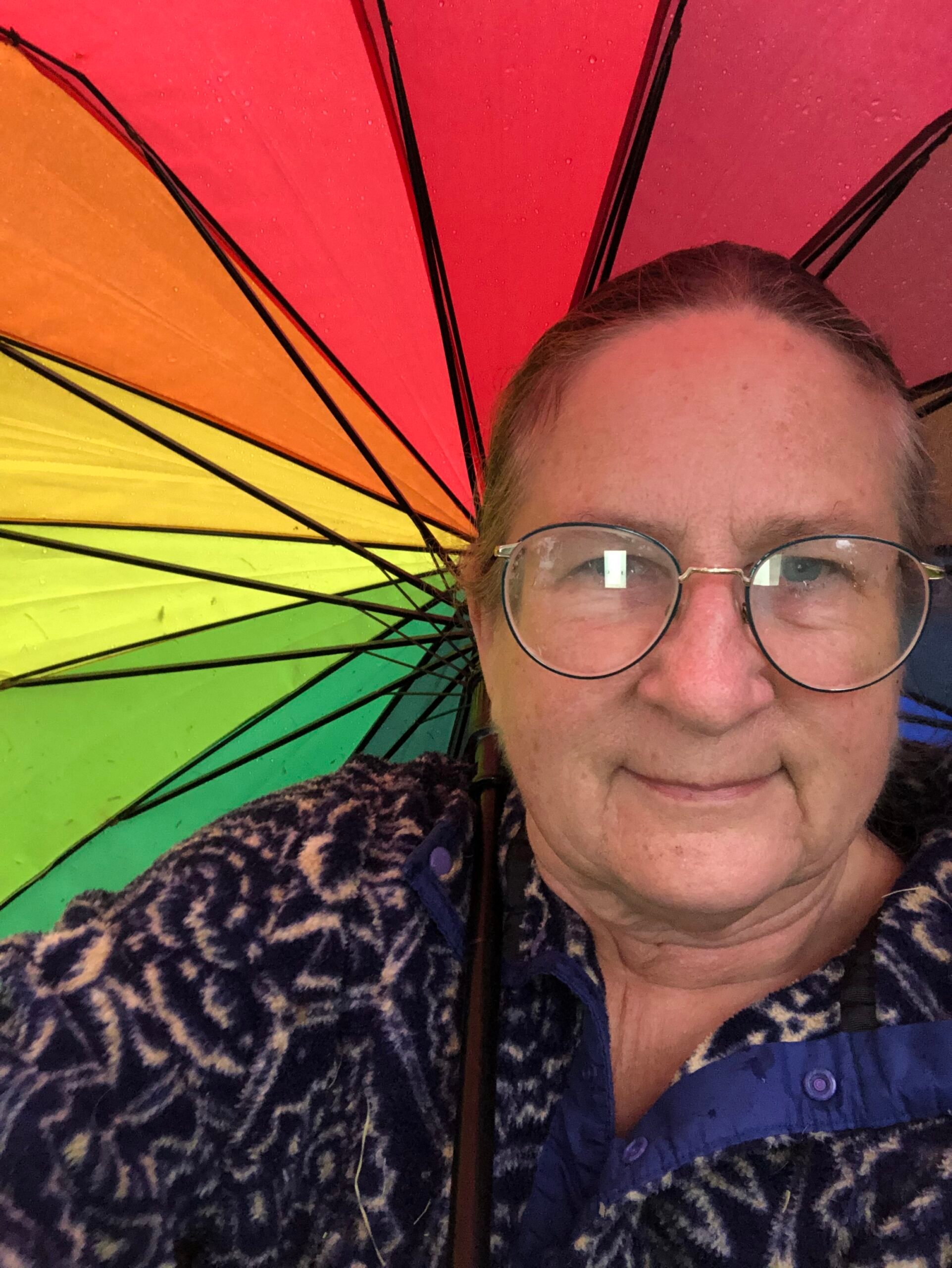
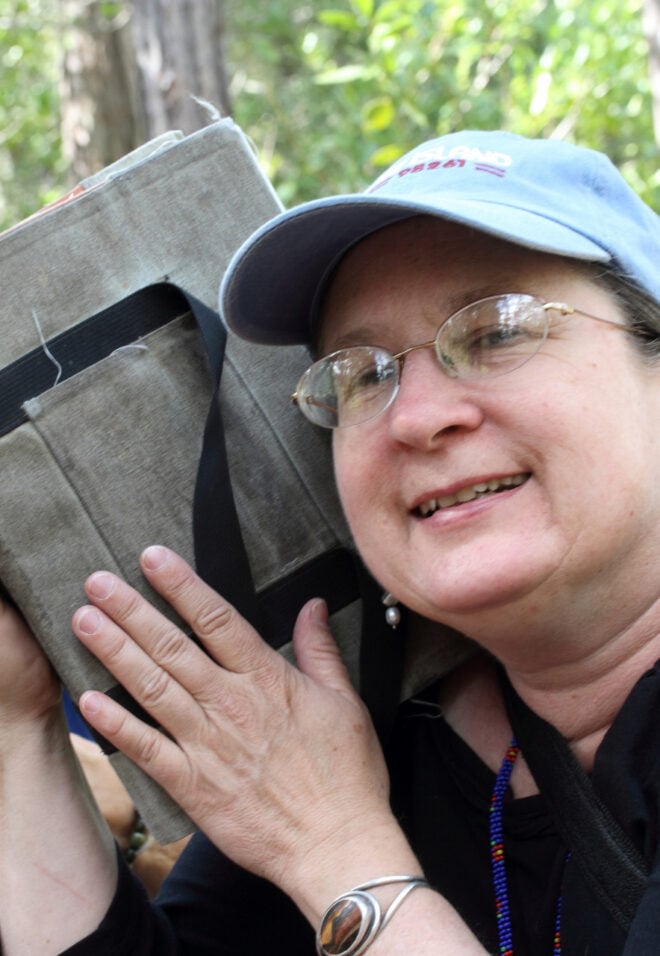
The author in 2011 with The Jepson Manual.
This academic perspective carries over when I teach botanical art, as I ask students to ponder what “botanical illustration” is. Literally, botany means the study of plants, and illustration means to show. In the strict sense, a botanical illustration must show something “based in science” about the plant subject. Traditionally, and at minimum, the artwork must be an accurate rendition of the subject in terms of attributes like proportions, fusion, and number of parts.
When you think about it, plant art is everywhere, from brocade-covered furniture to motifs in wallpaper to decorations on our clothes and plates. This is not all botanical art. In the science of botany, besides being accurate and well-executed, the one thing that makes an illustration scientific is the fact that each drawing is represented by a voucher specimen. This specimen data, such as accession number, collector, and collection number, is recorded on the illustrations and cited in the publication that includes the illustration, and the voucher specimen is deposited in an herbarium.
I want to emphasize that I respect and value not only scientific illustrations, but also other types of plant art. I find most artistic renditions of plants worthy of looking at, enjoying, and most certainly worthy of doing. I call these times of drawing and painting “long dates with plants,” for with every minute that I spend with the plant subject, I learn more and know it better. I can spend over 40 hours studying a plant, and when I look at it again, I will observe something new and different.
Some dates are just free and fun, like field sketching. Some dates are like doing an interview, where in a short period of time you need to learn as much as you possibly can about the plant to reflect its form accurately, as in my illustrations for The Jepson Manual (Hickman et al., 1993, Baldwin et al., 2012) or for the Channel Island floras, such as for A Flora of Santa Cruz Island (Junak et al., 1995).
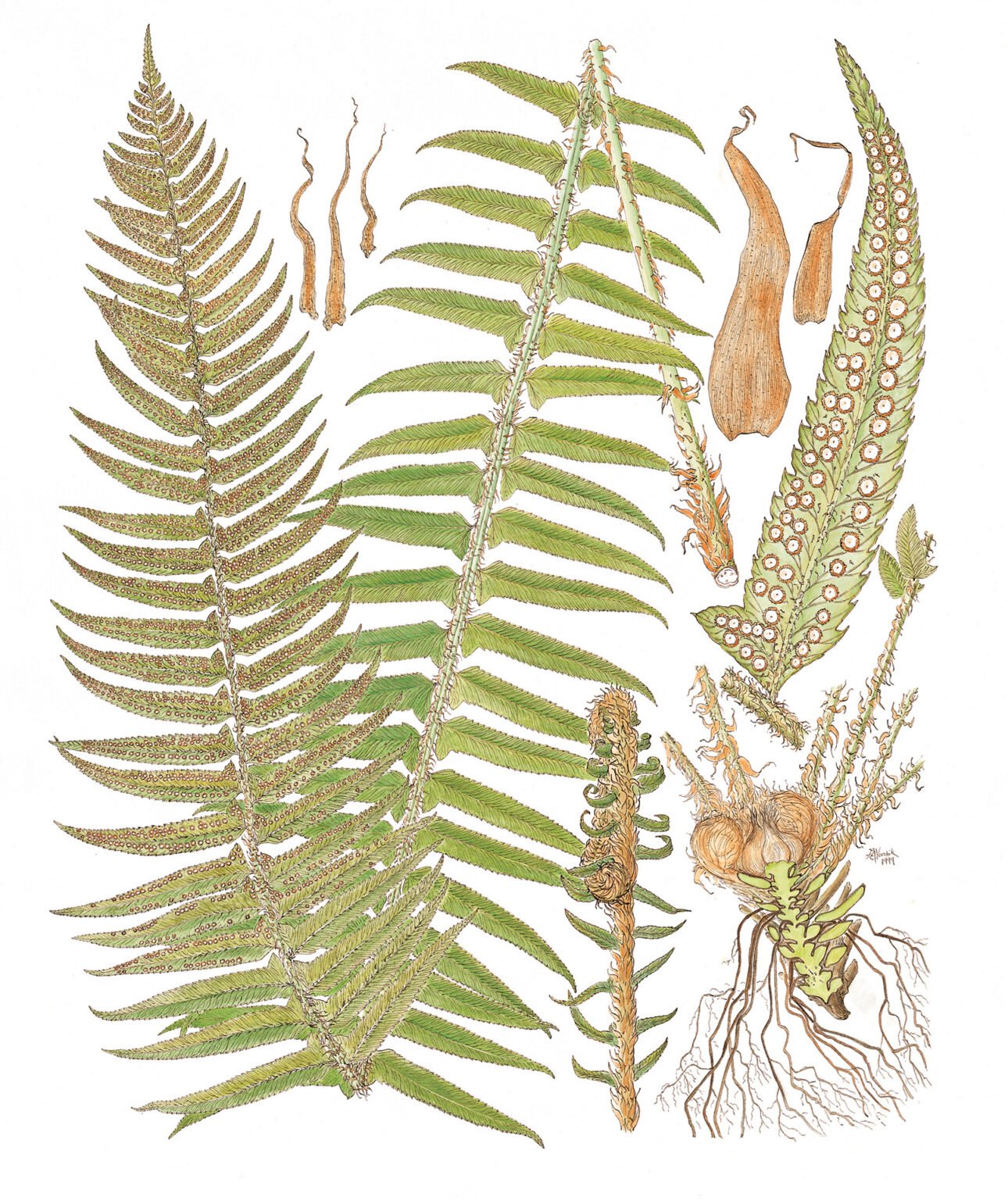
Every date is different. Some “long dates with plants” offer over 40 hours of study with a single plant, such as this sword fern (Polystichum). Illustration: Linda Ann Vorobik
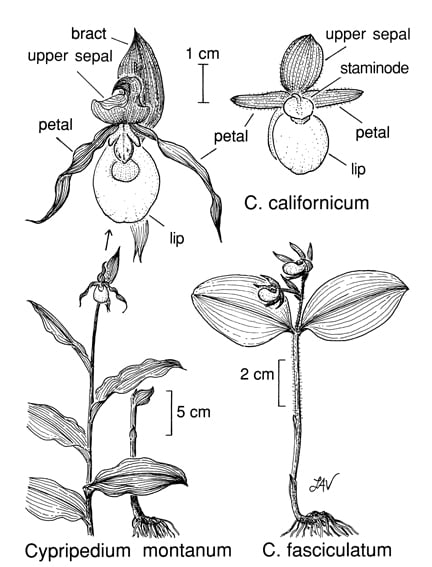
Other dates are closer to speed dating, a rapid-fire way to quickly get to know plants, such as these ladyslippers (Cypripedium spp.) Illustration: Linda Ann Vorobik, copyright University of California Regents
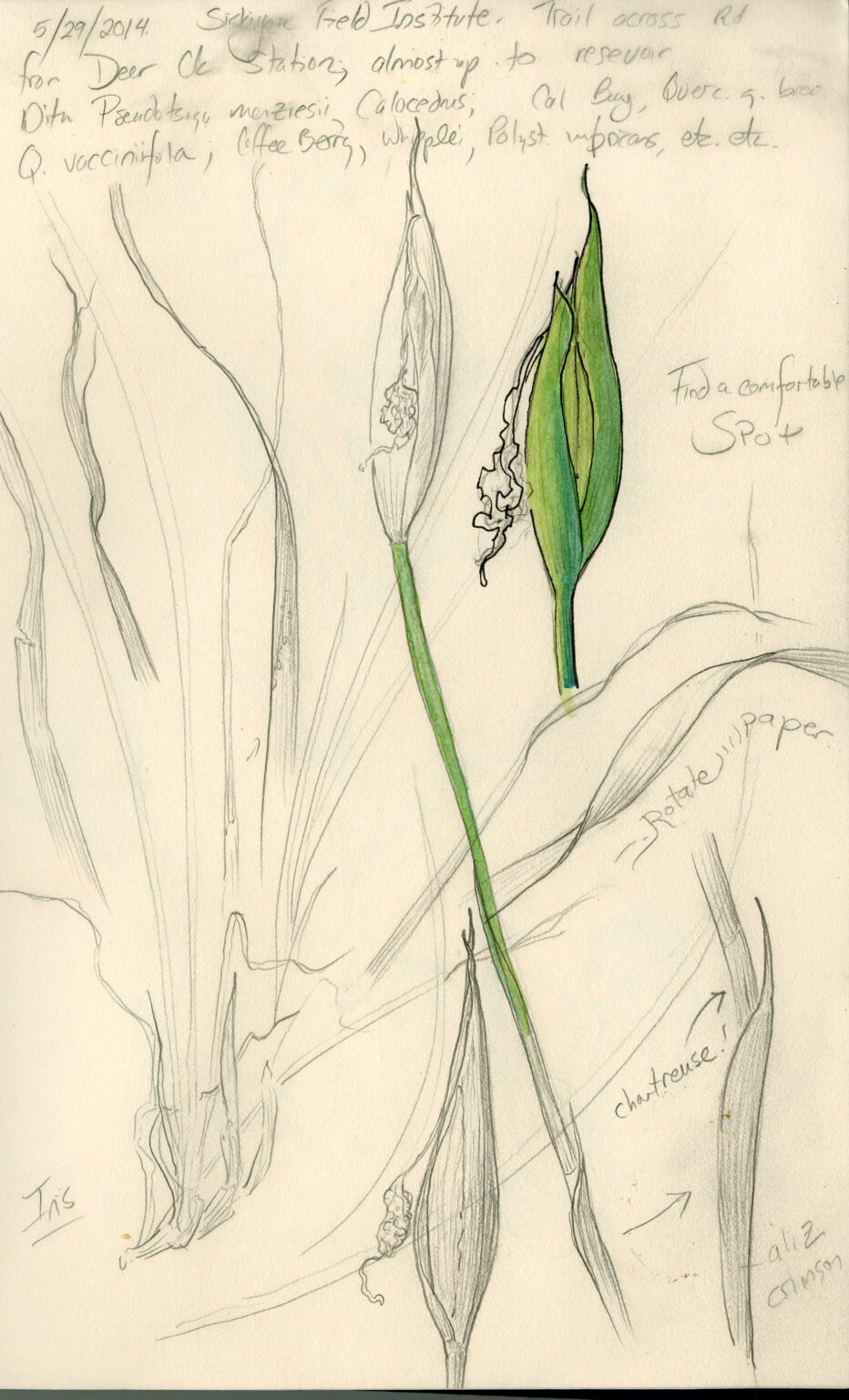
Some artistic "long dates wtih plants" come with no expectations at all, such as this iris (Iris) field sketch. Josephine County, OR. Illustration: Linda Ann Vorobik
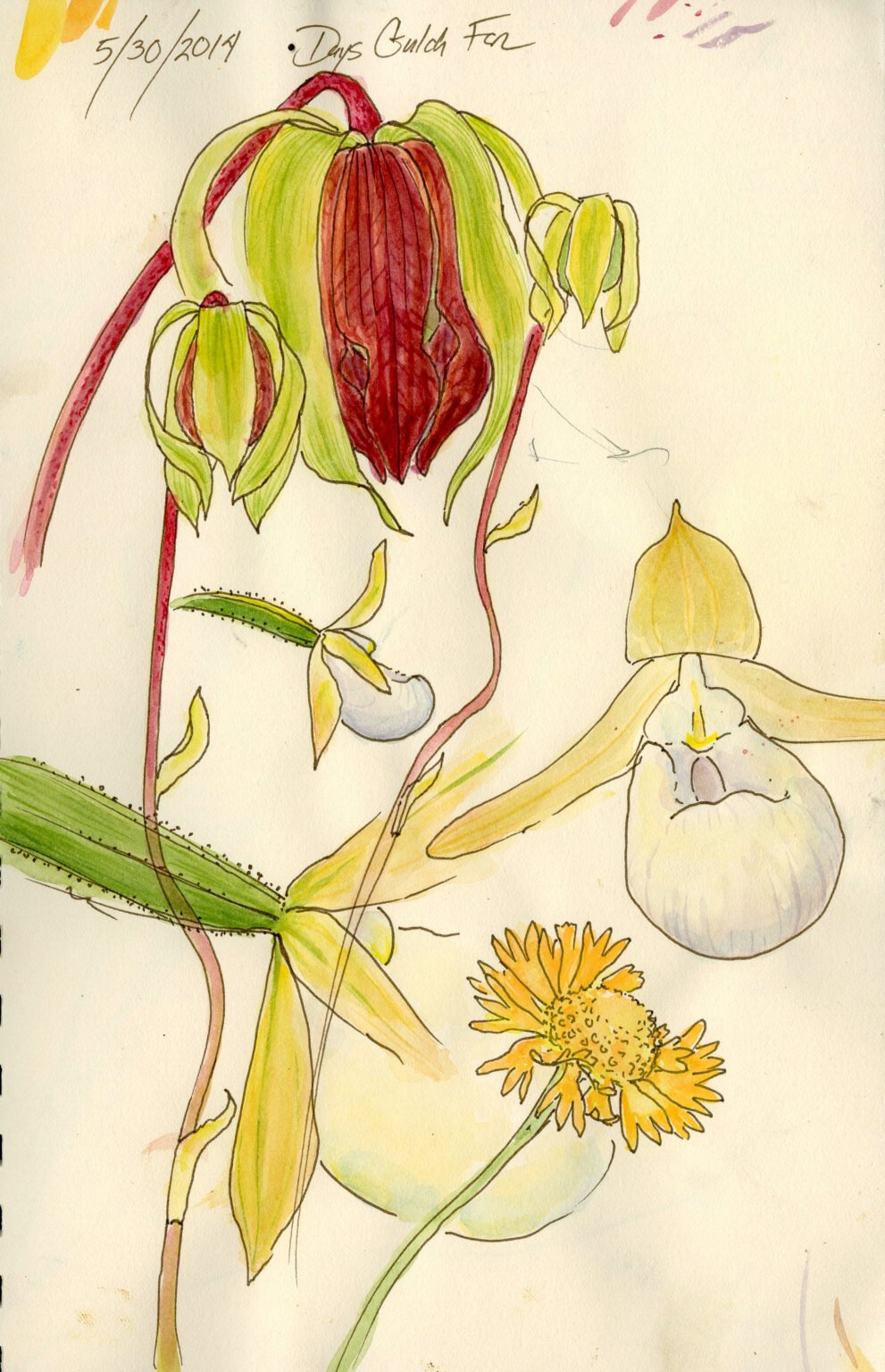
Field sketch of California pitcher plant (Darlingtonia californica), sneeze weed (Helenium bigelovii), and California lady slipper (Cypripedium californicum). Josephine County, OR. Illustration: Linda Ann Vorobik
The kinds of botanical illustration that I have done can be found in three major types of publications in botany. These publications each portray something about taxonomy.
The first type of publication includes botanical journal articles that describe new species. I have created many new species illustrations for botanists across the United States and in other countries. These drawings are not required for an article describing a species new to science, but they are, in my humble opinion as useful, or perhaps more useful, as the written description.
Species descriptions are the building blocks of the second type of publication, floras, which are the encyclopedic treatments of all the native and naturalized species of an area. Floristic treatments are publications that not only describe all of the species in an area, but often provide the most up-to-date classification and nomenclature for the species.
The most modern classification and nomenclature is in part found in the third type of publication: the taxonomic monograph, which is usually a revision of a genus or portion of a genus, such as Leila Shulz’s 2009 treatment of a portion of the sagebrush genus (Artemisia), which I was honored to illustrate.
In spite of my coming from the strict side of botanical art, I love the looser, freer side of artistic plant portraits and field sketching or journaling, as they invite anyone to have long dates with plants.
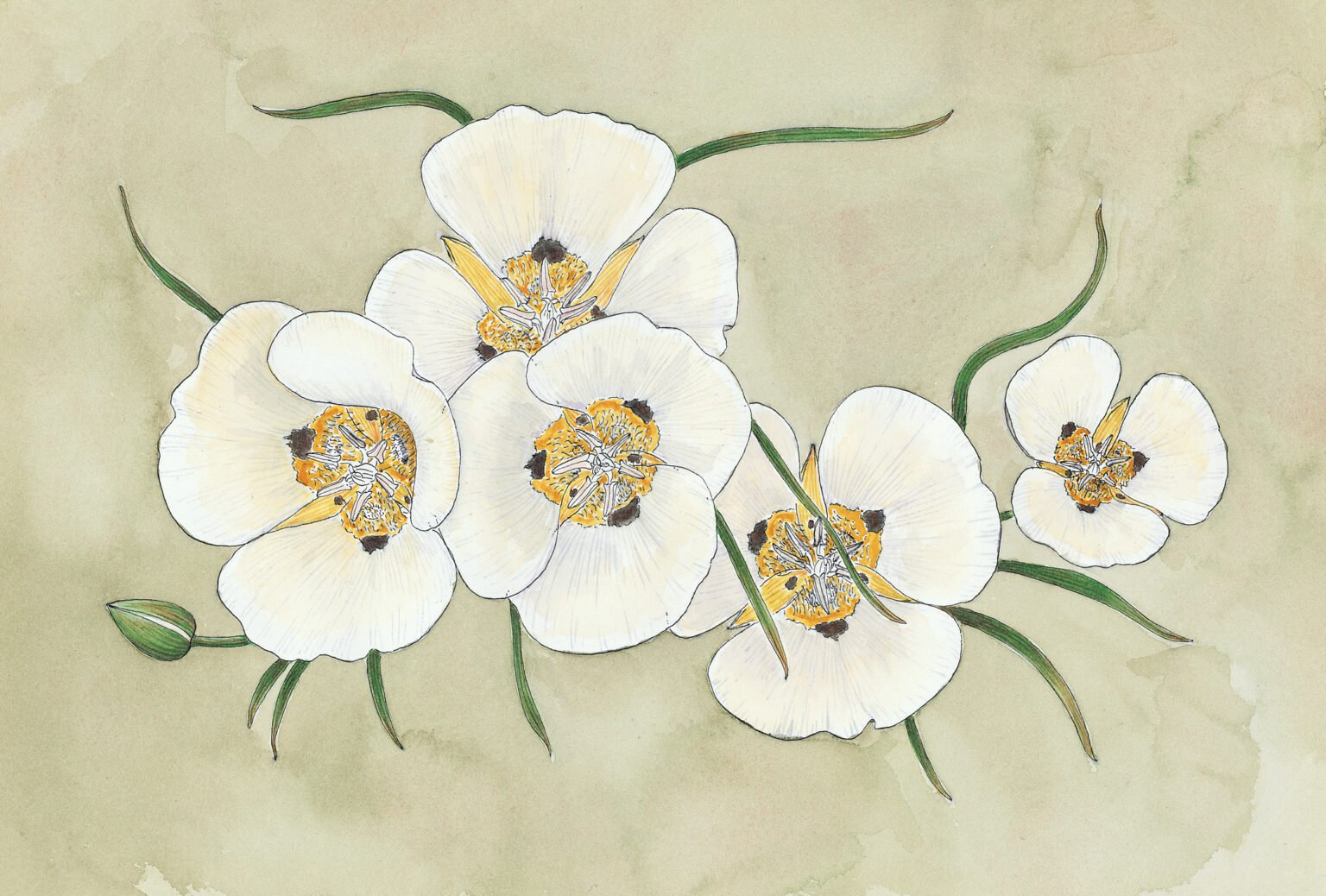
Artistic plant portrait of Leichtlin’s mariposa (Calochortus liechtlinii). Illustration: Linda Vorobik
In these times it is so important to find ways to feed our souls, to learn about the environment, and to teach others about the value of plants in our world. I contribute by getting others to spend long dates with plants and, to that end, we hope to continue with future articles about how to create botanical illustrations, do field sketches, and create botanical watercolors. Stay tuned!
Baldwin Bruce Gregg, Douglas Goldman, David J. Keil, Robert Patterson, Tomas J. Rosatti, Dieter Wilken, eds. 2012. The Jepson Manual: Vascular Plants of California. 2nd ed. University of California Press. Vorobik is principal illustrator.
Barkworth, Mary E., Kathleen M. Capels, Sandy Long, Michael B. Piep. 2003. Flora of North America: North of Mexico, Volume 25: Magnoliophyta: Commelinidae (in part): Poaceae, part 2. Oxford University Press. Vorobik illustrated some drawings to ink but designed most of the illustration plates including numerous new pencil drawings of grass details.
Hickman, James Craig, ed. 1993. The Jepson Manual: Higher Plants of California. University of California Press. Vorobik is principal illustrator.
Junak, Steve, Tina Ayers, Randy Scott, Dieter Wilken, David Young. 1995. A Flora of Santa Cruz Island. Santa Barbara Botanic Garden. Vorobik is sole illustrator for this and all of the forthcoming Channel Island floras.
Shulz, Leila M. 2009. “Monograph of Artemisia Subgenus Tridentatae (Asteraceae-Anthemideae).” Systematic Botany Monographs 89 (1–131). Vorobik is sole illustrator.
Taylor, Ronald J. 1992. Sagebrush Country: A Wildflower Sanctuary. Mountain Press.




Responses